What's New in Mathematica 8
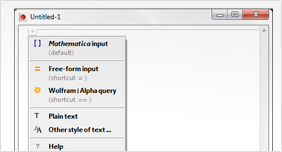
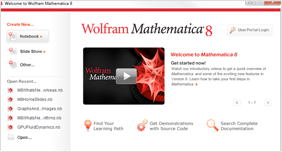
Mathematica 8 introduces free-form linguistic input—a whole new way to compute. Enter plain English; get immediate results—no syntax required. It's a new entry point into the complete Mathematica workflow, now upgraded with 500 additional functions and 7 application areas—including the world's most advanced statistics capability and state-of-the-art image processing.
New workflow end points include deployment of standalone applications or interactive documents.
Top 8 reasons to upgrade to Mathematica 8»
Core Algorithms
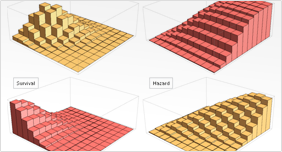
New superfunctions automatically compute the probability of any event and the expectation of any expression, estimate distributions from data, or quantify goodness of fit. »
A new streamlined process for parameter estimation and goodness-of-fit testing for built-in parametric distributions and derived distribution constructors, with automatic selection or user specification of routines. »
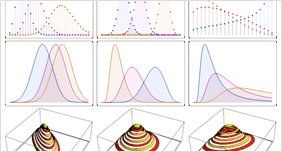
Work with 35 properties of 100 new distributions with specialized coverage of finance, medicine, and engineering. Includes automated parameter estimation. »
Mathematica 8 introduces new functions for fast manipulation of permutation groups and an extensive collection of operations to explore and visualize their properties. »
Easily define and use new distributions from data, formulas, or other distributions, including copulas, mixtures, order statistics, censoring, truncation, and transforms. »
Compute with powerful new algorithms for fast and exact linear algebra, integration of oscillatory functions, equation and inequality solving over domains, many special functions, and more. »
Application Areas
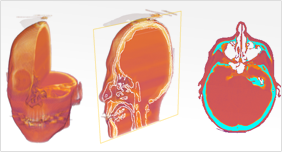
With many new algorithms added for real-time image acquisition, feature detection, and more, Mathematica 8 offers a complete environment and interactive workflow for image processing and analysis. »
Graphs and Networks
Graphs and networks are now fully integrated into Mathematica , including high-performance scalable data structures, advanced aesthetics, and broad modeling and analysis capabilities.
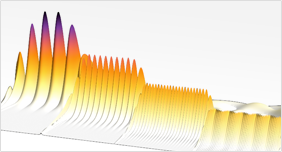
Apply discrete or continuous high-performance wavelet analysis for thresholding and visualizing in any dimension. »
Perform comprehensive derivative calculations, including exotic option pricing; compute bond values, sensitivity measures, and more; and calculate time value of money with a variety of effective interest rate scenarios. »
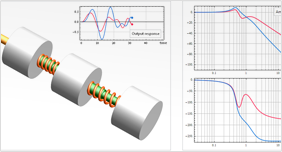
Analyze and design control systems using classical and state-space techniques, develop control solutions for analog and digital systems, and simulate models in open- and closed-loop configurations. »
Supports the latest Microsoft Excel file format; automatically imports more elevation, satellite, seismology, microarray, graph, and other data formats; and includes plugin architecture for user-defined formats. »
Other New Features
Enhanced geographical information systems
Software Development
Graphics & Visualization
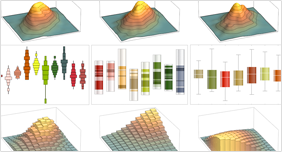
New statistics charts, including box whisker charts, quantile plots, and paired bar charts and histograms, with Mathematica 's automation and flexibility. »
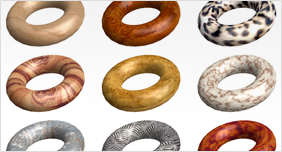
New scaling function support for 2D and 3D charts and histograms, new options for applying textures to surfaces and regions, improvements to discrete plots, and more. »
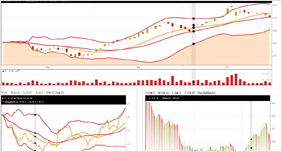
Instantly create customized interactive financial charts, applying more than 100 built-in financial indicators to your own data or built-in data feeds. »
Illustrate ideas or annotate graphics using improved drawing tools, including dynamic guides. »
Texture mapping of images to 3D surfaces with full hardware acceleration, built-in curve and filled curve primitives, and other new features. »
Interface & User Experience