Get started with Wolfram technologies, or work with us to apply computational expertise to your projects.
Questions? Comments? Get in touch: 1-800-WOLFRAM, or email us
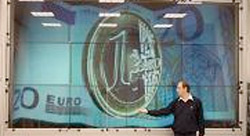
Create vivid, lifelike images for interactive 3D viewing displays.
Use Mathematica for product development to define and assess system parameters.
X3D Technologies GmbH, the leading creator of "glasses-free" 3D display screens, uses Mathematica for almost all of its product development. The company designed a 3D projection wall display with a diagonal screen size of over 15 feet (4.5 meters), which is believed to be the world's largest ever and has been featured in the 2005 World Exposition in Aichi, Japan. Mathematica was essential to the realization of this technological breakthrough and the timeframe in which it was accomplished.
"Glasses-free" 3D means that viewing aids such as glasses or virtual-reality helmets are not needed—the lifelike images can be seen by the naked eye at wide viewing angles and arbitrary positions. These stereo images consist of multiple, layered, 2D images or perspectives, and a key problem is to find the best distribution of perspectives that correspond to create a high-quality 3D visualization. Mathematica enables X3D Technologies GmbH to study the optical properties of these 3D images and systems, and to quickly check the effects of possible modifications. It also allows development and testing of the proprietary algorithms the company uses to produce 3D projection displays.
"The success of our 3D-display technology was due to using Mathematica from the beginning," said Dr. Ingo Relke, author, developer, and manager of the 3D projection system. "The combination of symbolic and numeric evaluations with the ability to produce image processing has allowed us to obtain fast, high-quality results and correctly inform the direction of subsequent development."
The creation of a large-scale glasses-free 3D display has very exciting implications for future projects in a broad array of fields, including the computer and film industries, engineering, and environmental sciences, to name a few. X3D Technologies GmbH also produces and tests other screens—all developed using Mathematica evaluation technology—ranging in size from ones for cellphones and PDAs, to midsize screens for medical imaging and gaming devices, to larger LCD and plasma screens of up to 50 inches for advertising and entertainment purposes.