Accelerate Design of an Industrial Hydraulic Press
Train a neural surrogate on a high-fidelity hydraulic press model, then explore the tradeoff among throughput, energy efficiency and cut quality across 100,000 design alternatives in minutes.
To run this example, you'll need
The latest versions of System Modeler and Mathematica.
Please make a selection:
Get afree trial Continue
with download
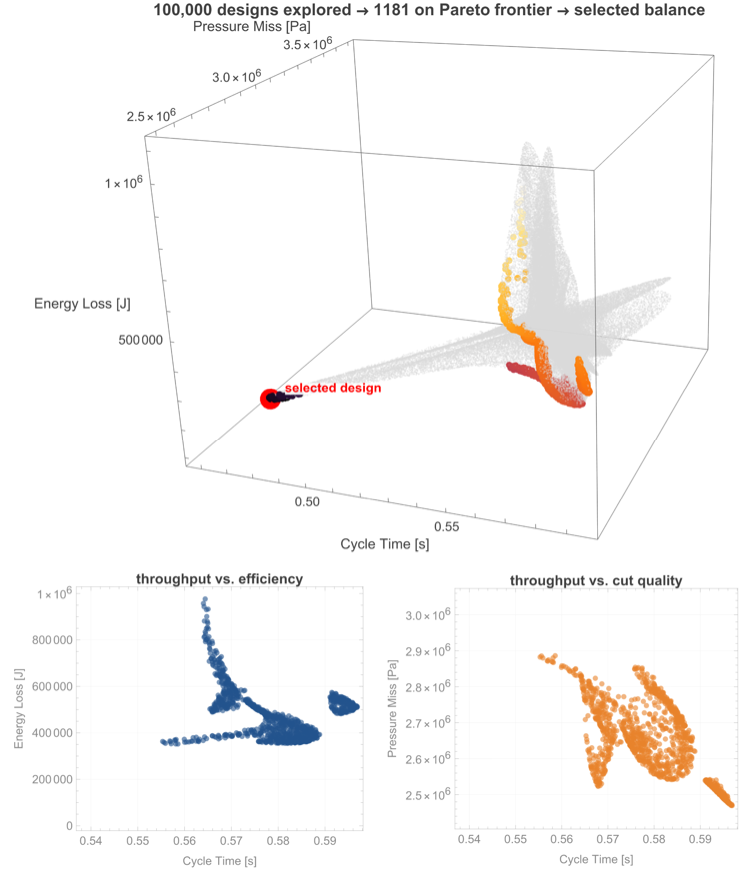
Surrogate-evaluated objective space for 100,000 candidate designs (gray cloud). The non-dominated set, the Pareto frontier, is the colored ridge along the lower-left edge.
High-Fidelity Hydraulic Press Model
A clamp-and-punch sequence circuit with two double-acting cylinders, a fixed-displacement pump, sequence and pressure-reducing valves, a relief valve and two 4/3 directional control valves.
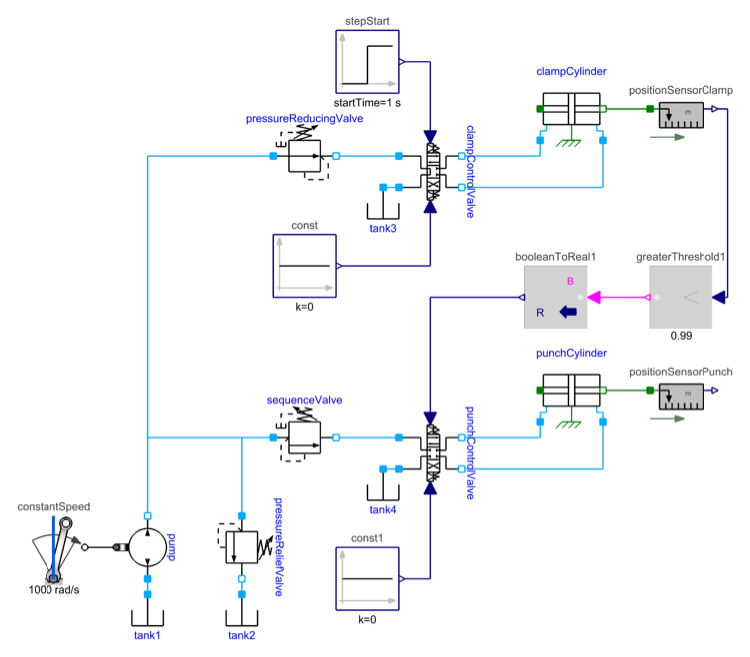
Model diagram of the sequence circuit: pump, valves and both cylinders connected via the full hydraulic schematic.
Create Neural Surrogate Model
A neural surrogate trained on ~300 high-fidelity simulations evaluates each design in milliseconds. The Monte Carlo sweep that takes ~28 hours against the full Modelica model completes in ~50 minutes against the surrogate.

The surrogate learns the relationship between press design parameters (pump sizing and valve openings) and operational metrics (cycle time, energy loss, peak pressure) directly from full-model simulations.
Automatically Create Neural Surrogate
Validate Surrogate
Compare the surrogate prediction against the full-model simulation.
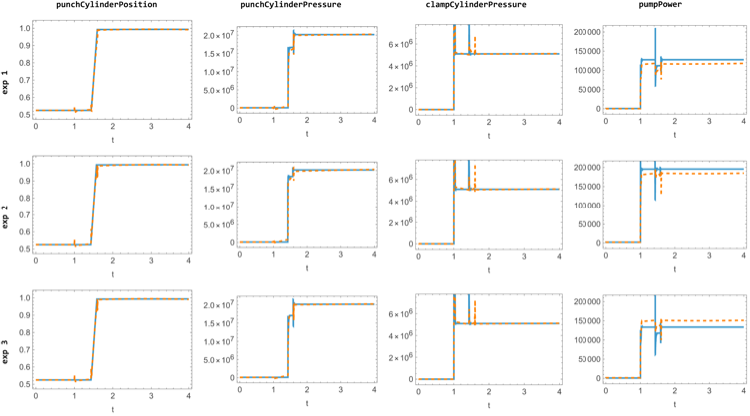
Three random designs across four output trajectories—12 validation panels.The surrogate (orange dashed) matches the full Modelica simulation (blue solid).
Efficient Optimization and Evaluation
A Latin hypercube draws 100,000 candidate designs from the 3D parameter box. Each is scored on the three objectives via a single surrogate inference per design. Dominated designs, those beaten on every objective by at least one other, are filtered out, leaving the Pareto frontier: the irreducible tradeoff surface. The designer can commit to a single point on this frontier by weighting throughput, efficiency and cut quality for the operation.
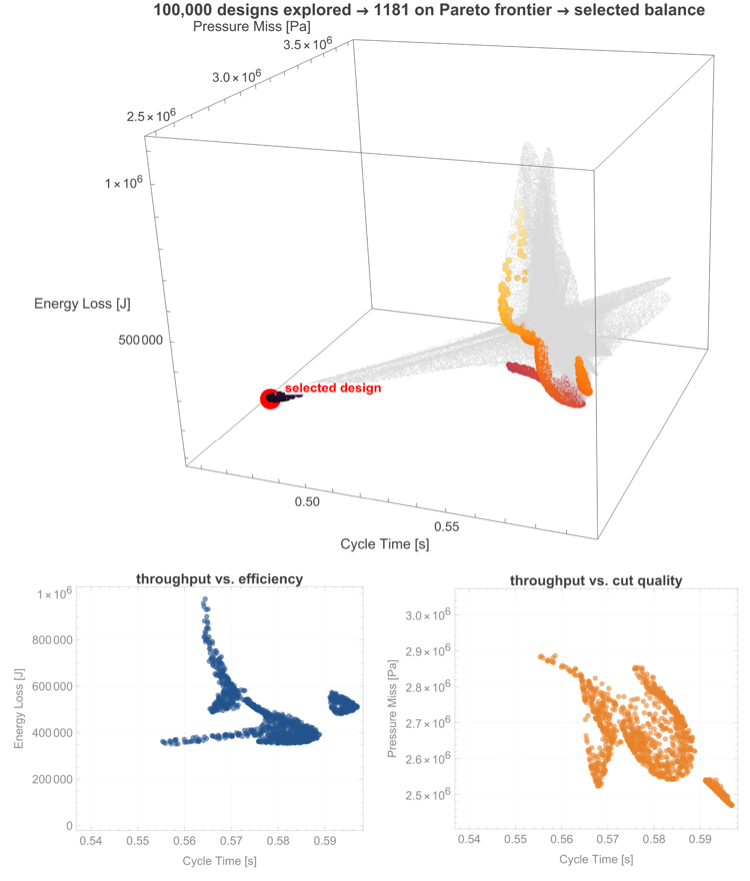
Surrogate-evaluated objective space for 100,000 candidate designs (gray cloud). The non-dominated set, the Pareto frontier, is the colored ridge along the lower-left edge.
Accelerate Multi-Objective Optimization
Compare Initial with Optimized Design
The Pareto-selected design trades a longer cycle for substantially less wasted energy per part. With weights of {0.25, 0.50, 0.25} (cycle time/efficiency/cut quality), the optimizer found that a smaller, slower pump paired with a wider-opening punch valve delivers the same cut at the same shear-threshold miss, while cutting per-cycle energy by roughly half.
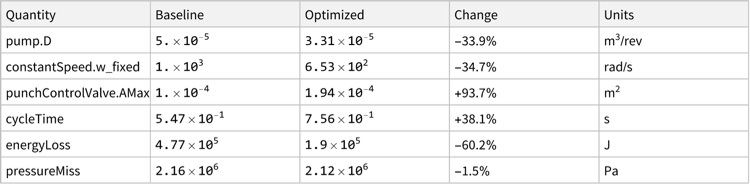
Baseline (model defaults) vs. Pareto-selected design. The optimizer cut energy loss by ~60% and pressure miss by ~1.5%, at a cycle-time penalty of ~38%. Reweighting the scalarization shifts the selection along the frontier without retraining the surrogate.
Wolfram System Modeler
Try
Buy
System Modeler is available in English
and Japanese
on Windows, macOS & Linux »
Questions? Comments? Contact a Wolfram expert »